
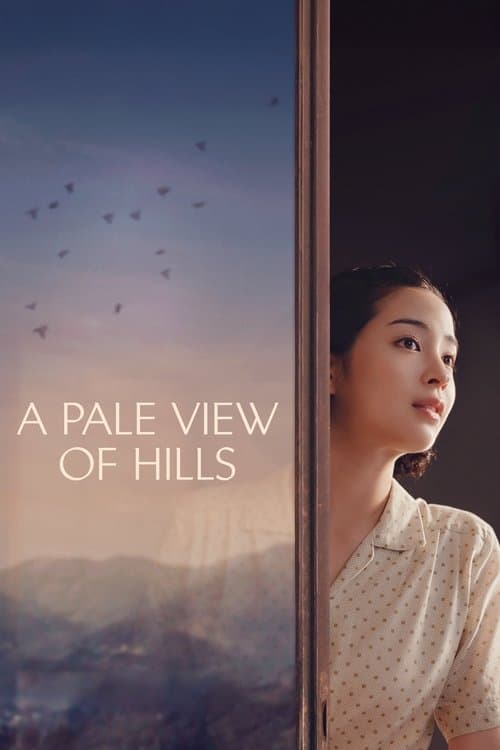
A Pale View of Hills
Synopsis
Dual timelines explore a Japanese widow's memories spanning post-war Nagasaki in 1950s and England during 1980s Cold War era, unraveling secrets that intertwine her past and present experiences across borders.
Main Cast

Suzu Hirose
Etsuko

Fumi Nikaido
Sachiko

Yoh Yoshida
Etsuko

Camilla Aiko
Niki

Kouhei Matsushita
Jiro

Tomokazu Miura
Ogata

Lynette Edwards

Rie Shibata

Daichi Watanabe
Romain Danna
Frank
Trailer
User Reviews
CinemaSerf
Set in two different timelines and in two different countries, this tells us of the reminiscences of “Etsuko” who emigrated from Nagasaki to the UK with her husband and young daughter. Time has marched on, her husband is now dead and as she is about to sell her bungalow, their aspiring journalist daughter “Niki” (Camilla Aiko) arrives to help her pack. She also announces that she has been commissioned to write a story based on her mother’s memoirs. Initially quite reluctant, she (Yō Yishida) begins to tell of her younger self (Suzu Hirose) and her life in post-war Japan where she is married and expecting a baby. Her husband “Jiro” (Kôhei Matsushita) is a very traditional young man who expects his wife to conform to traditional values - she even ties his shoelaces for him, but she is a bit more adventurous than that - especially after his school teaching father “Ogata” (Tomokazu Miura) comes to stay and she also meets “Sachiko” (Fumi Nikaidô) who is preparing to emigrate to the USA with her cat-loving daughter who becomes more pivotal to the story as it develops. The one thing that I found this seriously lacked was enough in-depth characterisation of the latter day “Etsuko”. In many ways she has the most to say, to reveal even, but this film rather reduces her to little more than a narrator of her life in the 1950s before they left their homeland. Clearly she has at least one secret, and as we progress there are some clues as to what that might be, but I felt we spent a little too long on the admittedly gorgeous look of the film and not enough on substantiating the narrative itself. That doesn't just apply to her, but the storyline of the conflicted “Ogato” who clearly had a role of some significance during the war is also a little too neglected. I have not read Kazuo Ishiguro’s original text so I’m not sure if these characters were so undercooked on the page, but here I felt oddly prurient as her story unfolded. Somehow this just didn’t ever find it’s groove and though I did quite enjoy watching it, I left the cinema feeling a little flat.


